February 26

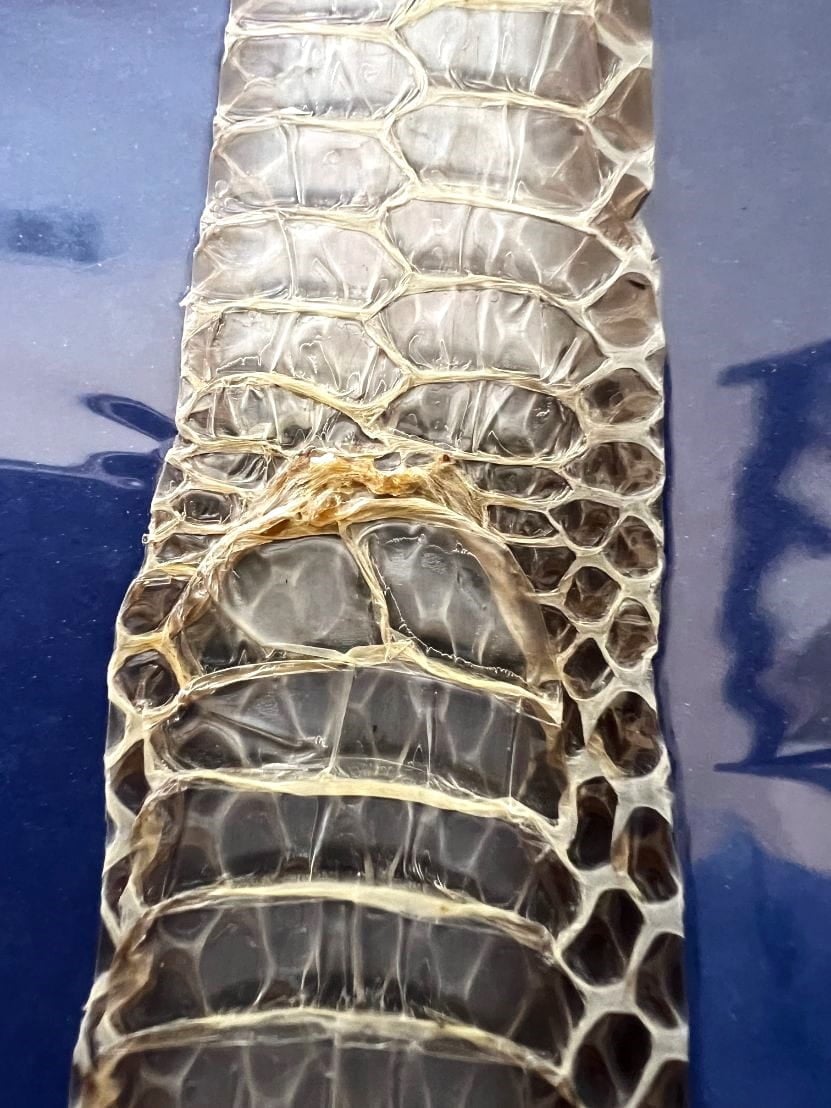
Snake Skin

Young scientists learn to use their senses to describe the observable physical attributes (such as shape, size, texture, and color) of natural objects. Acquiring sensory vocabulary is an essential science skill. Let’s focus on texture, how objects feel to the touch.

A reptile’s skin does not stretch as they grow, so they shed their old skin for a new one that fits their growing body. Laminating preserves the delicate skin and permits young scientists to observe the patterns and feel the skin without tearing it. (See related post.)

Use the side of an unwrapped crayon to make rubbings and to identify the texture.


Watch full screen here.

Related Posts

Copperheads

Snake Skins in my Science Lab

Textured Art

Bark

Feely Box

Fun Fact: To distinguish between nonvenomous snakes and pit vipers’ skins, find the anal plate which is the last belly plate and the beginning of the tail. Most nonvenomous snakes have a divided anal plate and a double row of scales from there to the tip of the tail. Venomous snakes have a single row of scales.
Category: Science | LEAVE A COMMENT
February 24

A New Challenge

The world is made of shapes and patterns. Use nature to teach your children to identify them.

After spying one natural semi-circle, I challenged myself to find more. It wasn’t a simple task, but I was successful! A semi-circle is half of a circle, while a semi-oval is half an oval. Be careful, a sphere is a solid shape, so half a sphere is a hemisphere. What a fun way to introduce fractions to our youngest scientists. Other math vocabulary may include symmetrical and diameter.


My brother captured this semi-circle.

Then look for ways that engineers and architects use semi-circles and ovals.


Related Posts

Concentric Circles

Hexagons

Stripes

Spirals

Doors

February 17

Contrails

We’ve all seen those white, puffy trails in the sky left by jets, but you might not know that they are called contrails, short for condensation trails. When the hot, humid exhaust mixes with cold air, ice crystals form and a cloud trail is created. This phenomenon will not occur if the air is dry.

The sunset changed these contrails orange! It was quite a light show!

Watch full screen here.

Related Posts

Crossing Contrails

Category: Science | LEAVE A COMMENT
February 13

Nature’s Hearts

I always watch for heart shapes when I explore natural spaces. Below are some of this year’s favorite new finds. Celebrate Valentine’s Day hunting for hearts outside with your young nature lovers.

Fun Fact: Heart and earth are spelled with the same letters.


February 11

Way Up High

It feels like spring in Atlanta, so I headed over to Chattahoochee Nature Center for a hike. My habit of looking all around, including upward, was rewarded when a heron landed high in the branches above me. Male herons search for branches which they carry to females to build their large nests. Nests are built in a rookery, a collection of multiple nests, high in tall trees near wetlands, lakes, or ponds. Females will lay two to six pale blue eggs which will hatch in 26-29 days.

Can you find the heron?


Watch full screen here.

Related Posts

Great Blue Heron

Nests

A Throwback

Another One

February 5

Winter Roses

Hellebores also known as Lenten roses bloom in late winter. These clump-forming perennials add a little beauty to the shades of brown that occupy my garden during the cold months. There are so many varieties from which to choose, and each year I try to add a new one. Deer have never chosen to eat the blooms or foliage, and they have survived unexpected drops in temperature. They are also a garden favorite because they require little maintenance and have a long blooming season.

Watch full screen here.

Category: Science | LEAVE A COMMENT